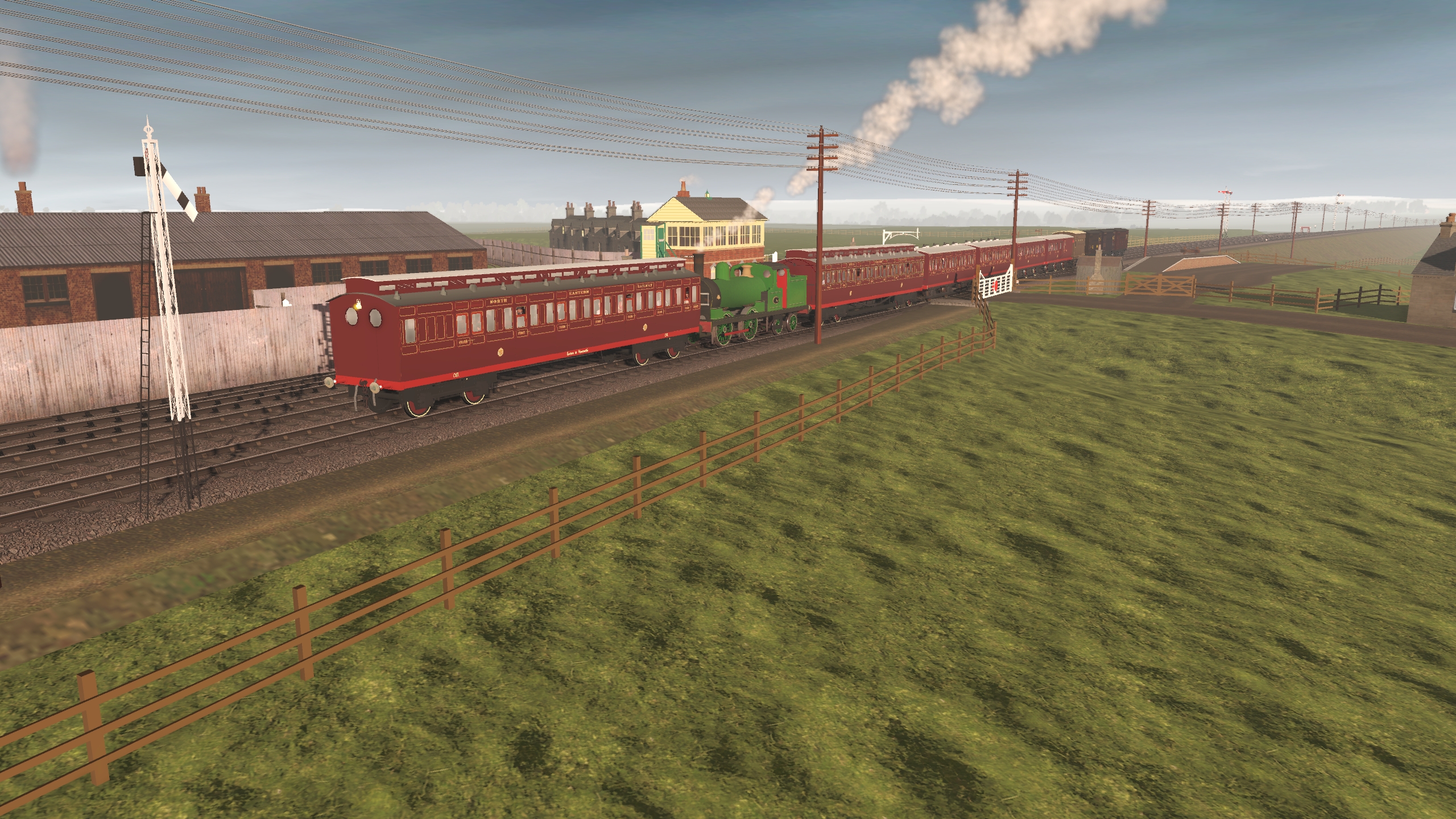
North East England - Steam Days Screenshots - Large Screenshots Possible

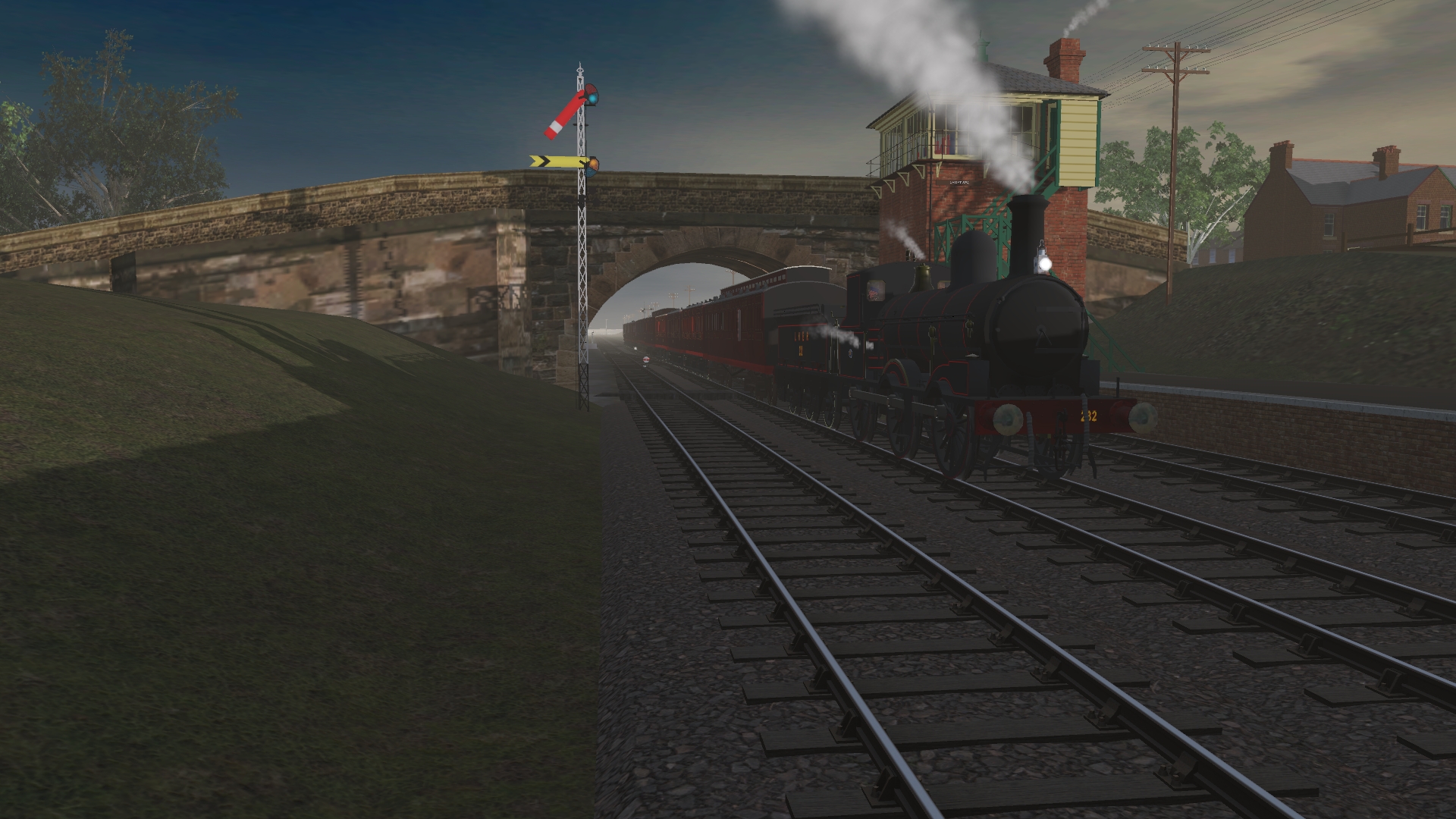
Croft Spa station.

BLmZD6Q.jpg


J22 0-6-0 passes through with race day special.

Built by McDonnell for the N.E.R. in 1883-85.
Despite his short tenure being because his designs did not impress the N.E.R's Directors his Class 59 0-6-0 went on to have a relatively long life, making it past the grouping and even being given a LNER Classification as J22.
 
Last edited:
North East England During the steam era.
A screenshot modified to represent an early colour photo postcard.


BLDb73B.jpg


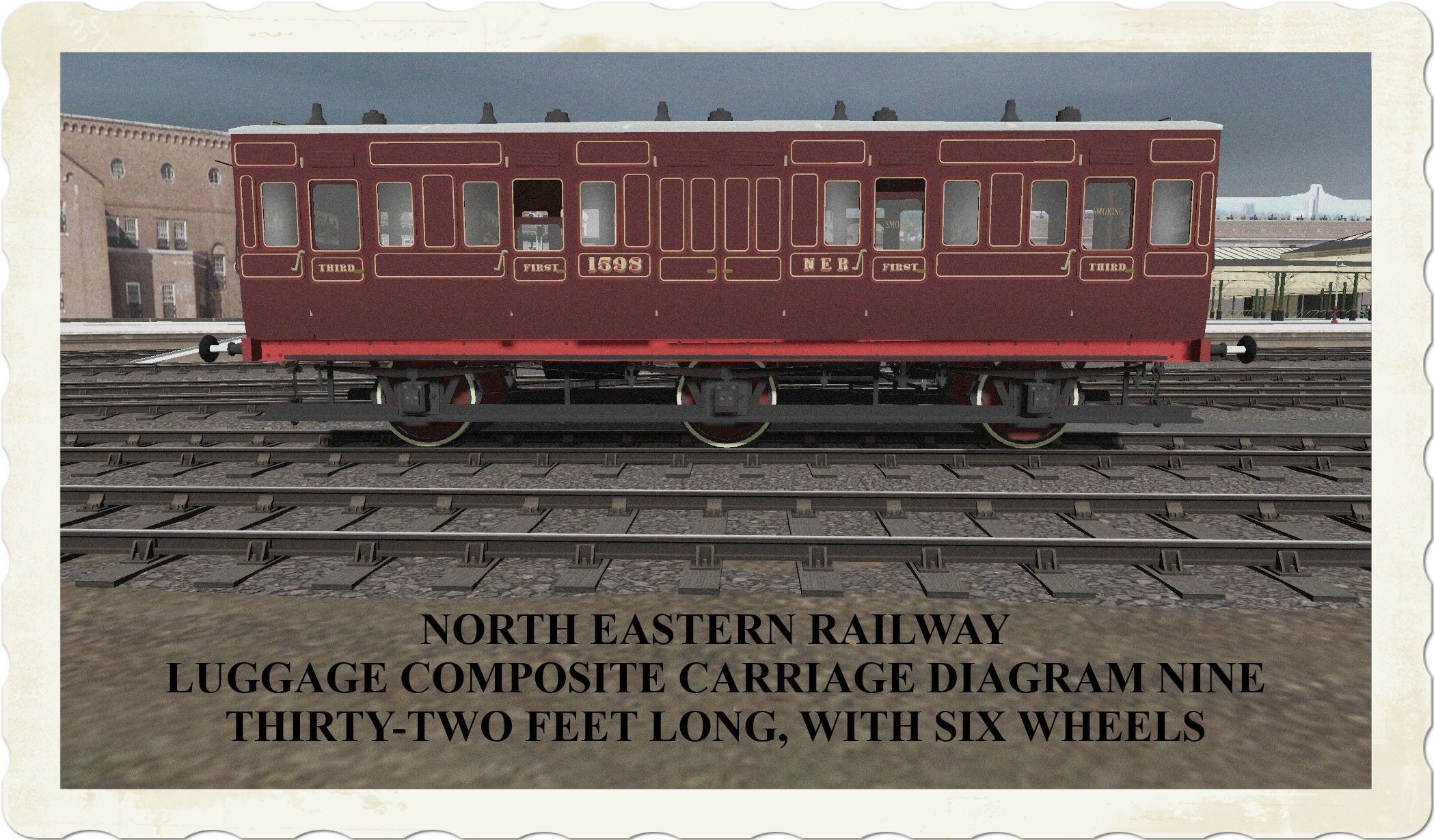
I have started on a series of commissions with Paul Mace of Paulz Trainz to produce six-wheeled carriages with luggage compartments and lavatories.

The first is the Diagram 9 Luggage Composite, with two First and two Third Class compartments with a centrally placed luggage locker.
One hundred and ninety-five were built at York between 1884 and 1893. However, according to the NER Carriage stock book one hundred and six of them had been converted to Diagram t by 1912
The stock book noted that no drawing was made for Diagram t, but this may be because the conversions were merely removing First Class interior fittings and replacing them with Third Class interiors, along with relettering of the doors. Looking at the stock book, typewritten entries indicate that fifty-eight Diagram t conversions were accomplished by December 1906, with handwritten entries showing a further forty-eight were carried out between 1907 and 1912. I believe that conversions started in 1896 as fifty-two foot bogie clerestory Luggage Composite carriages to Diagram 7 began to appear, displacing the Diagram 9 from the N.E.R's three long distance express train sets.

With One hundred and ninety five built there were far too many around to have merely been employed on the Leeds-Glasgow, Newcastle-Liverpool Exchange and Newcastle-Liverpool Lime Street sets.
Just how they were employed is unclear, since the first carriage roster we have for the North East is the 1926 LNER NE Area Carriage Roster, by which time the six-wheel type was gone apart from the luggage vans to Diagrams 21 and 171. With many 19th century long distance passengers, particularly First Class ones, tending to take a substantial amount of baggage with them then space was required to stow it. The early four wheel train carriages carried on the coaching tradition of the 18th century by stowing baggage on the carriage roof, where it was overseen by a guard sitting at the carriage end, but this practise gave way as carriages evolved, with both the guards and the baggage moving inside, out of the weather. There was just not the space to stow baggage trunks and hat boxes inside the compartment, so the guard's van was the natural place to put it.

Crime may have prompted passengers to desire their baggage to be stowed close by, where it was easier to keep their eyes on it. The archives show that stealing baggage from busy stations was done by even outwardly respectable people, such as Doctors and military officers!

It may be that the N.E.R. also deployed the Diagram 9 Luggage Composite on its "main line sets", of which the LNER had twenty in the 1926 Carriage Roster. There were possibly twenty-one of them in N.E.R. days pre-grouping. These were not the express trains to Glasgow and Liverpool but rather the passenger sets which the NER ran along the East Coast Main Line and some the branches connected to it. York was the operational limit to their range in the south, with Tweedmouth/Berwick at the north, though one set, number seven reached Edinburgh on its daily travels. All twenty sets rotated through different daily set diagrams (set 7 did not correspond to a single physical "main line" set of carriages, it was a different one each day).

During the 1880s and 1890s of their operating heyday the Diagram 9s likely also appeared in timetabled passenger trains between Leeds and Hull, York and Scarborough, Hull and Scarborough, Newcastle and Middlesbrough as well as Newcastle and Carlisle. In other words serving the busiest stations on the N.E.R. where long distance travellers changed in and out of long distance express trains.

After 1896, they followed the established pattern of railway use of its carriages. In the beginning they would have been kept in good condition to act as substitutes and strengtheners, covering for failures and extra demand respectively. Evidently, as time progressed the company felt that they had too many of the composite type on its hands and began to convert them to all Third Class. At that time it was not the later BR practise of just declassifying a carriage but rather the replacement of First Class seating with Third Class benches, along with the removal of such things as curtains and the plush carpets. Still, the extra legroom remained, which the regular Third Class passenger will have not failed to notice, which likely made them attractive for a more spacious journey.

As enough of the new bogie carriage types were deployed a further decline down the pecking order was inevitable. The N.E.R. had a substantial excursion, special train and charter business to cater for and some of that business required First Class seating. Race Day specials were one kind of demand and Premium Excursions/Charters were others. A works, church or association/club trip might require several First Class seats for senior managers/church officials/association leaders and the like. One business, that of Party Trains ( Charters moving Theatre Groups and Music Hall companies around) might also want some First Class seating for the Group owner and leading artists.

In the end though, the six-wheeler became an anachronism and would not satisfy any passenger. Just when that came about is unclear. By the grouping, or at least 1926 they had disappeared from timetabled passenger trains, which put the N.E.R. ahead of many of its competitors. I have said before that the former G.N.R. passengers in rural Lincolnshire could still find themselves boarding an old Holden six-wheel banger as late as the end of WWII.

 
North East England During the steam era.
A screenshot modified to represent an early colour photo postcard.


BLbL6EN.jpg


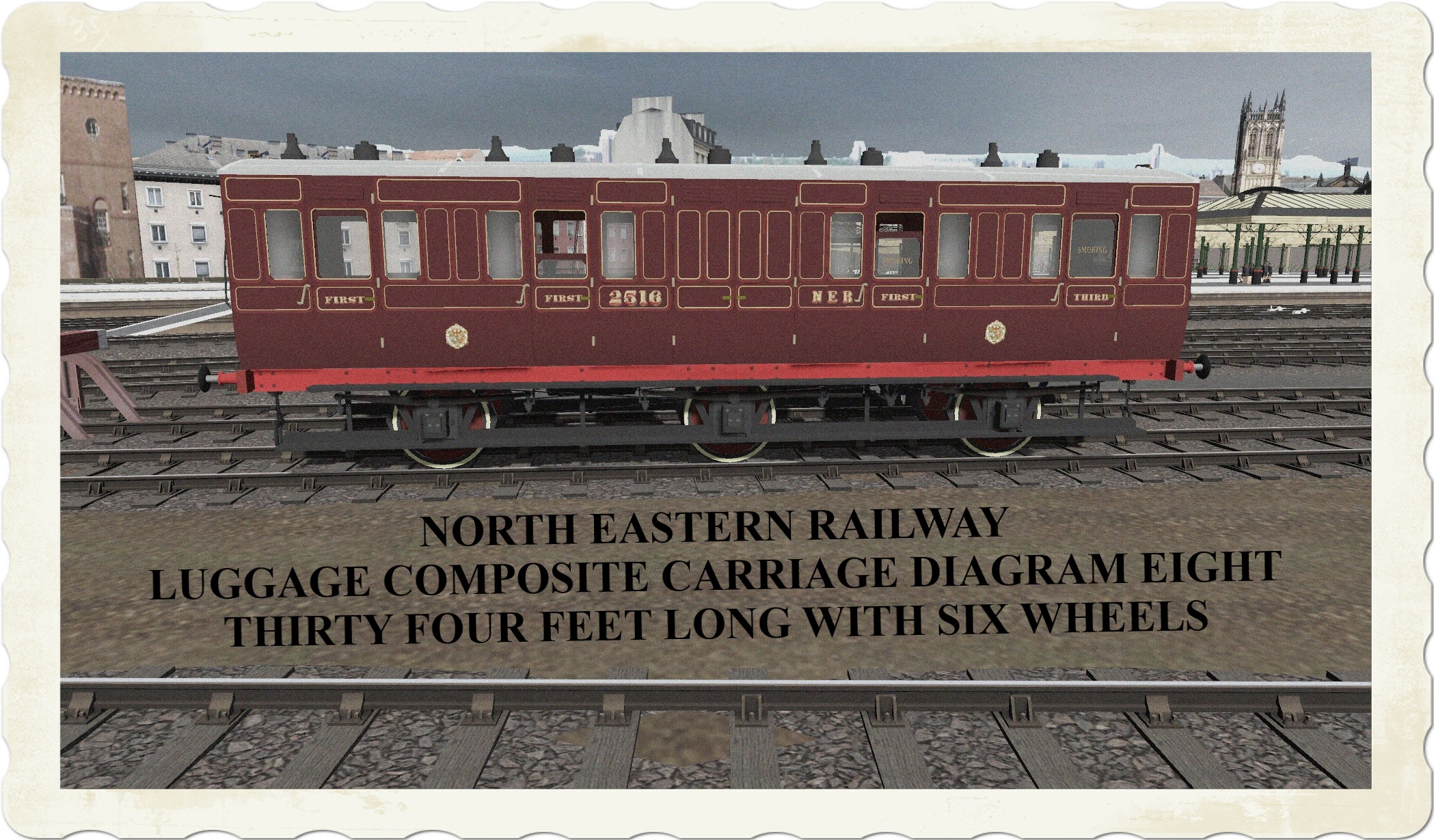
I have started on a series of commissions with Paul Mace of Paulz Trainz to produce six-wheeled carriages with luggage compartments and lavatories.

The second is the Diagram 8 Luggage Composite, with three First and one Third Class compartments with a centrally placed luggage locker.

Only three were built at York, in 1893.
With a thirty-four foot length all four compartments were of First Class size, of seven feet two inches in size. However, with one of them being classified as Third Class it is unclear when they became a Composite.
Their entry in the 1906 Stock Book, which was issued in December 1906, has all three as typewritten entries showing as 1893 build and classified as Luggage Composite. The procedures at the time were that they entered their classification at the time of the stock book issue and retained their original build dates, whatever they later became. Handwrittem amendements, which in the case of the 1906 book carried on until 1912 recorded alterations for 1907 through 1912, but again, kept the original build dates.

Therefore, it is unknown if the Diagram 8 ever ran as Luggage Firsts or not. If they did, then all were converted to Luggage Composite by 1906. Given that the first N.E.R. carriage book with the Diagram 8 in it as a Luggage Composite is dated 1897 then the conversions, if any, were done by then. There is no note on the drawing of any conversion, so the carriages may have left the works brand new in the configuration, with the decision to turn them out with one large Third Class compartment taken after building had begun but before leaving works.

With only three being built they hardly represented a large increase in the type built by the N.E.R. though the Three First Class compartments might have placed one in each of the three of the N.E.R. express train sets. If they required removal for repair or mainenance, so long as the train met the required total of First Class seats noted in the carriage roster then another Luggage Composite, such as the Diagram 9 could be used instead. The carriage rosters were never "set in stone" but were merely the minimum advised by the passenger managers. There were never enough Diagram 8s to assign to the "main line" sets, so it is unlikely they were deployed there. These carriages would have been built for a particular identified traffic reason and the decision would have been in 1892. Unless one trawls through any surviving passenger committe minutes or director's meeting minutes I do not know what may have occurred to change their minds in 1893 when the carriages were being built. Perhaps they were meant for a premium traffic flow, such as found between Harrogate and Bradford or that between Beverley and Hull. perhaps Scarborough-York or Harrogate-Leeds.

In any event, by 1897 the Diagram 7 52ft Bogie Luggage Composite in company stock had reached twenty three of its eventual one hundred and thirty-four examples built, so cascading had either already happened or imminently beckoned. The Diagram books have no conversion to Luggage Third recorded and nor is one recorded in the 1906 Stock book for the period up to 1912. therefore I think it reasonable to believe the Diagram 8s soldiered on as Luggage Composites until their final disposal, probably in the pool of carriages catering to excursion, special and charter trains. If there was a military charter train, taking troops from Newcastle, Leeds, York or Hull to a training camp in the 1890s, 1900s or 1910s then if the trips were relatively short distance then perhaps they were used.
 
Looking through the NERA archives I have stumbled across a NER booklet concerning special trains over the weekend of Saturday 19th and Sunday 20th of February 1910.
It runs to fourteen pages.

Multiple Theatrical Companies are on the move. Some are moved by ordinary passenger train, with reservations being made on their behalf. An example for Saturday being "The Slater Family", where a compartment is to be reserved for them between Newcastle and Carlisle on the 1.18 pm, though their journey is noted to begin at Middlesbrough at 11.00 am. Their destination is Dumfries. Presumably there are not more than ten of them if they are to be accommodated in a single compartment, unless some are children. Further down they return from Dumfries the following day, sunday February 20th, leaving Carlisle at 12.20pm and travelling on ordinary passenger trains via Newcastle and Darlington. Some theatrical groups and artistes travelling by ordinary passenger train have a van or carriage truck, sometimes sent by a different train to the destination.

For Theatrical groups moving by special train numbers, where listed vary between 11 and 90, with quite a few of them between 30 and 40.

One of them, The Royal Italian Circus moved on the Sunday from South Shields to Ednburgh, with empty stock running from Newcastle to South Shields at 7.30 am. the train is made up of an engine fitted with water scoop, a Brake Third Lavatory with dual brake, Third Lavatory with dual brake, 8 Horseboxes and four vans. This carried 37 passengers, an elephant, a zebra, 13 ponies (as 6 1/2 horses), 19 ponies (as 38 dogs) 4 goats and 31 dogs. The N.E.R. had six 52ft bogie Van Lav Thirds in stock in 1910, all 1906 slab sided matchboard type from 1906. They had a small Guard's van at one end, a Lavatory at the other and a compartment running from the Lavatory past five compartments to compartment six. Diagram 113 and built specifically for excursion traffic. This was certainly a better carriage than many Third Class passengers had to travel in even if it lacked end gangway connections.

Also travelling from South Shields to Edinburgh on the same train were "The Davis Trio". There were 10 passengers and they occupied the TLV, which was a six-wheeler.

The four vans may well have been hound vans given the numbers in the Circus, unless the circus wanted them to be able to travel with their handlers in the passenger carriages. In that case the vans could have carried baggage, set items etc.

There was probably not a "big top" ten to accommodate as, in 1905 "The Royal Italian Circus" was the name for the site we know as the London Palladium. At some point after that, but before 1910 it had closed, since the London Hippodrome circus was more successful and the London Palladium opened as a new building in December 1910. The group at South Shields may have used either a theatre or a music hall to perform in.
 
Last edited:
Some more information about the set provided for the move of the Royal Italian Circus and The Davis Trio on Sunday February 20th 1910.
The special train notice lists: BTLV, TLV, 8H, 4 Vans, but the breakdown for the two groups are as follows;

The Royal Italian: BTLV, 8H, LCK, 3 LK and 2V.
The Davis Trio: TLV and LCK

I have unearthed a document in the NERA archives, the Coaching Stock research newsletters 1, 2 and 3 by J.B. Dawson no less and dating back to 1963.
His research also included N.E.R. telegraphic codes.

BTLV: The code listing table has no BTLV! A 6-wheeler Lavatory Third TL/TLV (the V indicating dual braked Vacuum/Westinghouse) and if it had a corridor was TC/TCV . A 6-wheel Brake Third (non-lavatory) was B/BV.
A 52ft Van Lavatory Third was XBL/XBLV. A 52ft Corridor Third Lavatory was XTC/XTCV. Whatever the BTLV was, it had vacuum brake. I am presuming that BTLV is either a typo or known company "shorthand" for an unusual carriage, the 52ft Van Lavatory Third with Corridor, the Diagram 113.

FYI - The N.E.R. did not evolve a category or prefix letter for its vestibule/gangway end connector carriages which were longer than 52ft. The standard NER length for these was 53ft6in. Catering stock could be even longer.

TLV: 4 or 6 wheel Lavatory Third with dual vacuum/Westinghouse brake. ( A Third Class Corridor Lav 4-wheeler was TC or TCV). The N.E.R. never built a six-wheel Van Lavatory Third "BTLV" or six wheel Van Lavatory Third with Corridor "BTCV". There were no such codes in the newsletter table. Was that an oversight by JB Dawson writing in 1963? He was writing 40 years after the grouping, though he was the son of Eastgate's Stationmaster and wrote about personal recollections as far back as 1917.

H: Horsebox
LCK: Covered carriage Truck 21ft.
LK: Open carriage truck 21ft.
V: Van, Westinghouse brake

Hounds vans had the NER codes HN and HNV, so no hounds vans were provided. The dogs therefore travelled either in the horse boxes or in the BTLV.

In any event, there are two carriages and twelve trucks/vans listed in the stock for the 7.30 empty stock working out of Newcastle but there are two carriages and fifteen trucks/vans departing South Shields, with only two vans for the Royal Italian. I might be correct in assuming that the Three LK and single LCK were already at South Shields, with two empty vans being left behind as not required.
 
Last edited:
The NERA archive has multiple examples of "Programme of Special Trains". During 1910, Easter fell on Sunday March 27th and the booklet for the week to Friday March 25th runs to 88 pages. Many sets, including the Main Line sets, Newcastle and Carlisle, Newcastle and South Shields, Sunderland sets, Darlington Link A, Link B and Leeds Link A sets were all strengthened to some degree for the period March 24th through March 29th.
In the case of the Main Line sets the wording is "to be made up to summer strength", while for Newcastle and Carlise sets the wording is "to be made up to 6 bogie vehicles". The Darlington Link A and Link B sets are explicitly strengthened by a six-wheel Third carriage (a Diagram 15) , with the Link A sets gaining a bogie Luggage Composite too (a Diagram 7). Sunderland sets were "to be made up to 4 bogies and 3 six-wheel Thirds". Leeds Link A sets were to gain a bogie Luggage Composite and to be located within the brake in the set. The programme also instructed all passenger guards for the period March 24th to 29th to record in their journals whether their trains were underserved or overserved for the traffic, and to what degree.

On Saturday March 19th England were playing Scotland at Rugby Football in Edinburgh as part of the Five Nations Tournament. A special train was laid on from Newcastle to Edinburgh with five saloons, five Thirds and two Brakes (bogie corridor lavatory, steam heated in the notes, so some carriages were evidently NOT steam heated in 1910, the six-wheelers?). The saloons were for North Durham FC, Mr Sinclair's party (2 saloons), Mr Wallace's party from North Shields and the Rev. Wardropper's party. Passengers for this train from stations other than Newcastle had to get to Newcastle Central by ordinary train. It left Newcastle at 9.48 am with only two stops in Northumberland, at Morpeth and Alnmouth. While there was no stop at either Tweedmouth or Berwick there was a seven minute stop at Dunbar. If you were travelling in an odinary carriage without lavatory then that was where you had to make the most of that stop for a bathroom break. Southbound, the train left Edinburgh at 7.35 pm and did not stop at Dunbar in the up direction. The train stopped at Alnmouth and then stopped for seven minutes at Morpeth (10.08-10.15 pm). Newcastle arrival was 10.42 pm. England won the match 14-5.

On the same day, a half-day excursion was run from Amble to Newcastle and Sunderland. The engine was from Alnmouth and the passenger carriages were from Alnwick. The train set was eleven Thirds and two Brakes and must have been six-wheel stock as the Amble platform was not long enough to take thirteen bogie carriages. The working timetable allowed ten minutes for the empty stock from Alnwick to move on to the branch at Amble Junction and for the locomotive to run around the train before proceeding onwards to Amble. The train departed Amble at 12.45 pm, stopping at Broomhill, Chevington, Widdrington, Longhirst, Pegswood, Morpeth, Heaton and Manors East with arrival at Newcastle at 2.07 pm. After a five minute stop it departed for Sunderland, stopping at "Football Platform" (probably for Roker Park) and Monkwearmouth, arriving Sunderland at 2.51 pm. Sunderland were at home to Blackburn that Saturday, drawing 0-0, but Newcastle were away at Tottenham Hotspur, winning 4-0. The train laid over at Ryhope Grange Junction. The return journey from Sunderland began at 8.31 pm, stopping at only Monkwearmouth before departing Newcastle at 9.07 pm after a ten minute stop. Stops were at Heaton, Morpeth, Pegswood, Longhirst, Widdrington, Chevington and Broomhill. Amble was reached at 10.27 pm. The empty stock left Amble at 10.40 pm, reaching Alnwick at 11.25 to drop off the carriages. The Locomotive reached Alnmouth at 11.42 pm, which was a long day for the footplate men.

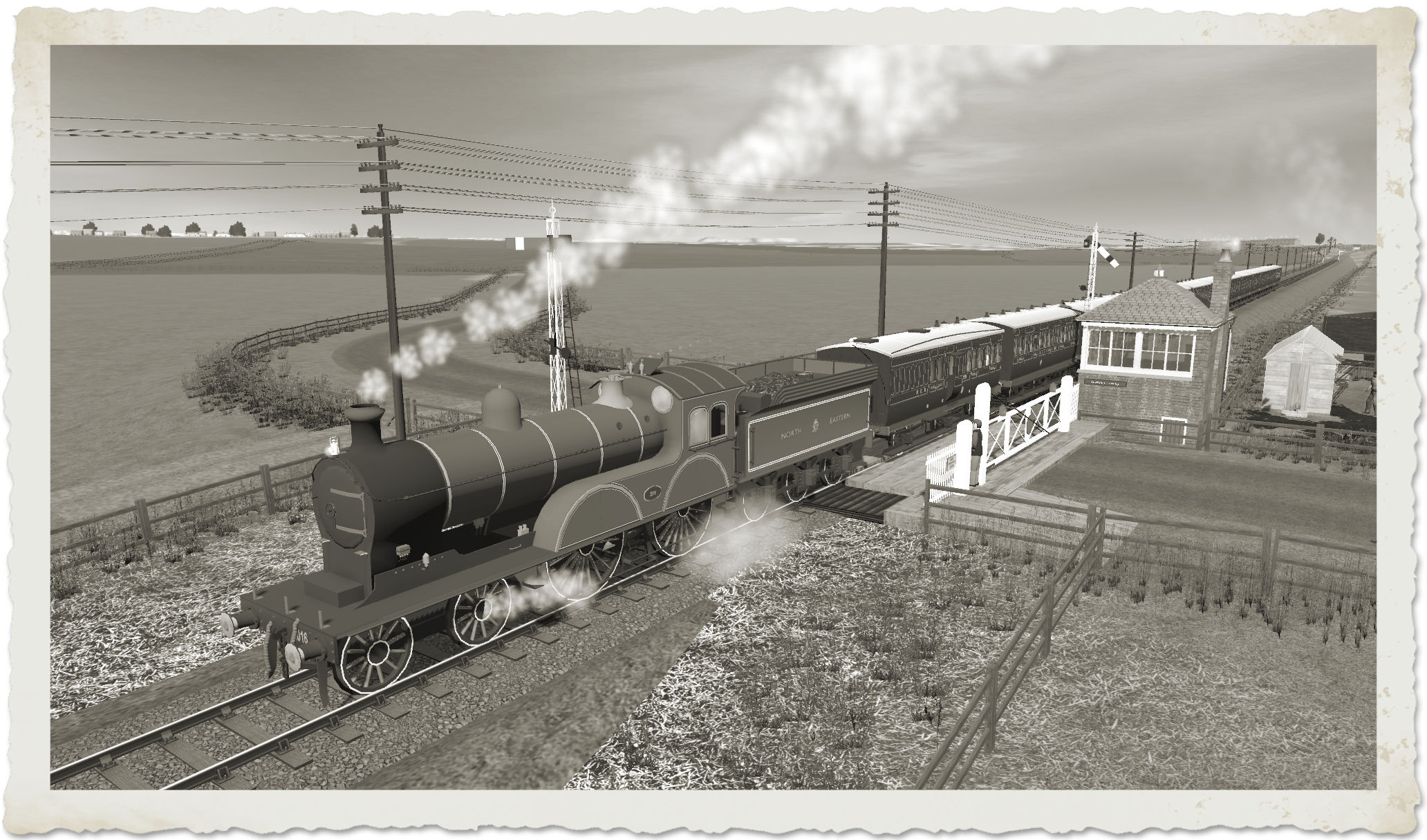
I have put the Amble excursion in the hands of an R Class 4-4-0, several of the class being on shed at Alnmouth.
The screenshot is modified to reflect the platinum developing process in use between the early 1900s and 1920.

BQfCYf1.jpg


The R Class takes its train through Township Crossing between Broomhill and Amble Junction. The train would have offered around 600 Third Class seats and I wonder how many people from Amble and the five stops before Morpeth took the chance for a cheap ticket in order to go to Newcastle or Sunderland for the afternoon and evening? The match at Sunderland, the shops in Newcastle and Sunderland, the pubs, bars, theatres, music halls, cinemas and dance halls in both places too.
 
Last edited:
A screenshot reproduced from my thread on the N.E.R. BTP Steam Autocars in the Prototype Talk Thread.

Northeast England during the steam era.
Maunday Thursday, March 24th 1910.
Durham Horse Fair is on.
The Programme of Special Trains booklet issued for Saturday March 19th through Friday March 25th had instructions for both the Horse Fair, working of horse boxes and strengthening of services, including the strengthening of steam autocar services.
The 4.25 pm from Sunderland for Durham was explicit, strengthen the steam autocar with a composite, two thirds and a brake third.
Given that the Programme also limited the addition of horse boxes to four per passenger train I have had Sunderland add four spare horse boxes to the train, rather than send them via Newcastle.
The horse boxes will be empty, with the fair drawing to a close with the afternoon and they must be dropped off, possibly by the station pilot and placed in one of the southern UP bays or docks.
They won't be going forwards with the steam autocar since the train departs Durham at 4.58 pm for Barnard Castle via Bishop Auckland. It will end its day at 6.55 pm at Darlington, moving as empty stock today, departing Barnard Castle at 6.20 pm.
Normally, the 5.20 pm steam autocar from Bishop Auckland to Barnard Castle departed for Darlington as a passenger train at 5.57 pm. but changes are effective in the week prior to and following Easter.


BQTaW1p.jpg

Passing Frankland Junction and brickworks.
 
Last edited:
I have returned to the Programme for Special Trains booklet for Sunday February 20th 1910.

The special trains have a requirement for thirteen "BTLV" type carriages (van lavatory with corridor) across ten different theatre/circus/music companies and using seven different special express trains from Newcastle to York, York to South Shields, Newcastle to Edinburgh and Newcastle to Carlisle.
I must look in to the 1906 stock book to try and work out which carriages they actually were, since the Diagram 113 52ft bogie van lavatory with corridor ran to just six examples.
The NER stock book lists the following as being 52ft Van and Lavatory (corridor).

Diagram 113 - six built in September 1905 for excursion traffic with matchboard sides and round roof.
Diagram 165 - thirteen built between November 1907 and 1909 (six in 1907, seven in 1909). The stock book lists them as for Immigrant Traffic, not excursion work, which would have placed them at Hull for workings to Liverpool, not in the newcastle District.

That gave them nineteen of the non-end gangway type to utilise on moving charter parties in special trains.
Perhaps immigrant traffic was not year-round, or was significantly lower during the winter months, which could explain the availability of the Diagram 165s during February 1910.

There were also the 53ft6in Van Thirds with corridor and end gangway connectors to Diagram 157 of 1908 (three built) but the Diagram 194, (single example built) did not appear until 1912.
However, they were meant for the premier traffic on long distance N.E.R. expresses and so very unlikely to be pressed in to excursion or charter services during 1910..


Just why the Programme for Special trains uses BTLV rather than XBTLCV I do not know, unless having that C in there could be misread as a Composite rather than as a corridor.
perhaps the NER codes JB Dawson looked at had evolved between 1910 and whichever list of codes he worked from.

There also existed Lavatory carriages with locker and corridor.
These were the 52ft Diagram 114 (5 built in 1906) and Diagram 164 (5 built in 1907). The stock book explicitly states the latter was for Theatrical Traffic. In the stock book the Diagram 114 has lavatory struck through, replaced with corridor, though the diagram shows the locker, the corridor and the lavatory.
I am beginning to think that the code system was straining to reflect the six aspects to a Diagram 114 (52ft length, Third Class, presence of a luggage locker, presence of a lavatory, presence of a corridor and possibly vacuum brake added to make it dual brake).

Why some of the theatrical groups have three BTLV allocated when a BTLV and two Diagram 114s would have made for an adequate through portion for working on foreign metals I do not know. There is something I am still missing about the enigmatic BTLV. I have looked at former ECJS carriages cascaded to the N.E.R. but none fit either the type or date of cascading for the Programme in 1910. Conversions of ECJS stock to saloons appears to have been happening, but not to a van with third class compartments, a lavatory and corridor.
 
Last edited:
The BTLV type has just become even more enigmatic for me.

One of the train sets for an excursion on Saturday August 21st included a TLV (3575 type) and BTLV (832 type). This was in the Programme of Special Trains booklet for the Northern Division applying from Friday August 19th through Saturday August 27th 1910. The excursion was to Scarborough from Shotley Bridge on the Newcastle - Blackhill Derwent valley branch. It was a 4.15 am departure so the passengers had to be "up with the larks". The route taken was Shotley Bridge, Scotswood, Newcastle, Gateshead West, Durham, Darlington, York, with stops at all stations between Shotley Bridge and Chester-le-Street, then stops at Durham, Ferryhill and Darlington. Arriving Scarborough Washbeck Excursion Station at 8.46 am the passengers got twelve hours in the resort. Departing at 8.50 pm and reaching Shotley Bridge at 1.35 am. Up to twenty-two hours out of the house!

I assume that 3575 and 832 are carriage numbers, since they do not match either a diagram number nor a drawing number in the Diagram books. The 1906 Stock Book listings identify the TLV (3575 type) as a Diagram 117 six-wheel Lavatory Third with short corridor and was an ex-ECJS carriage. However, the same stock book listings identify BTLV (832 type) as a Diagram 163 Lavatory Third with corridor! No Guard's van. Therefore, what qualified to be a BTLV? The Diagram 163 52ft bogie Lavatory Third with corridor, like the Diagram 165 52ft bogie Brake Lavatory Third with corridor is noted as being for immigrant traffic. There were 53 diagram 163s on the company's books in 1910.

This train ran in August, at the height of summer, so presumably immigrant traffic was at high levels. Now I am wondering to what degree the carriages officially designated for immigrant traffic were actually used in that role?

The excursion train had five saloons allocated, along with five Thirds, two Brake Thirds, the TLV (3575 type) and the BTLV (832 type). With the two Brake Thirds having Guard's Vans the "BTLV" did not operationally need a Guard's Van, so did that unofficially bestow some latitude on what was provided? Like the Saloons, the TLV and BTLV were reserved for named parties and not for general use. Birtley Iron Works party (Birtley - Scarborough) for the TLV, Mr Speed's party for the BTLV (Lamesley - Scarborough).
 
Back
Top