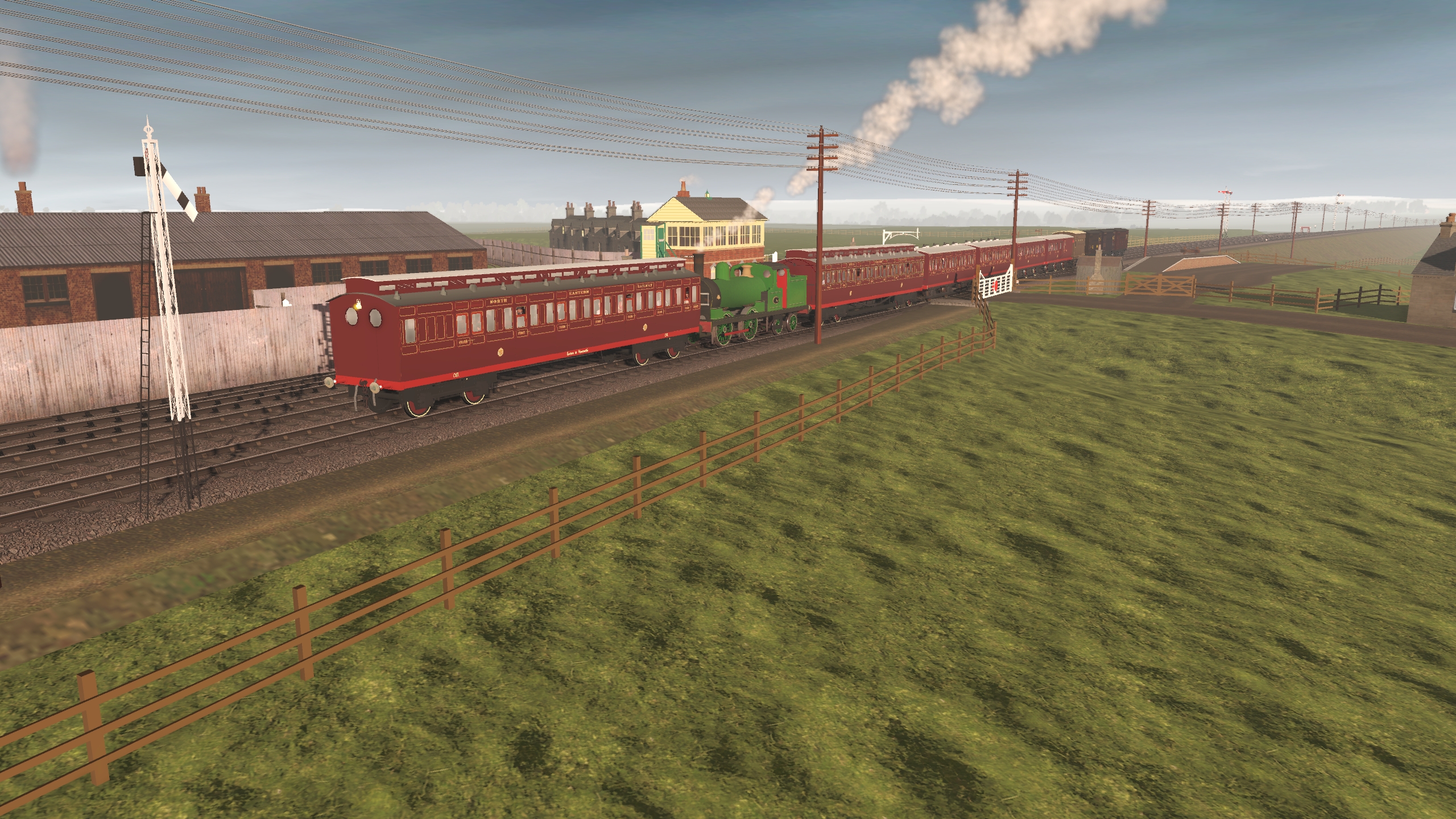
North East England During the steam era.
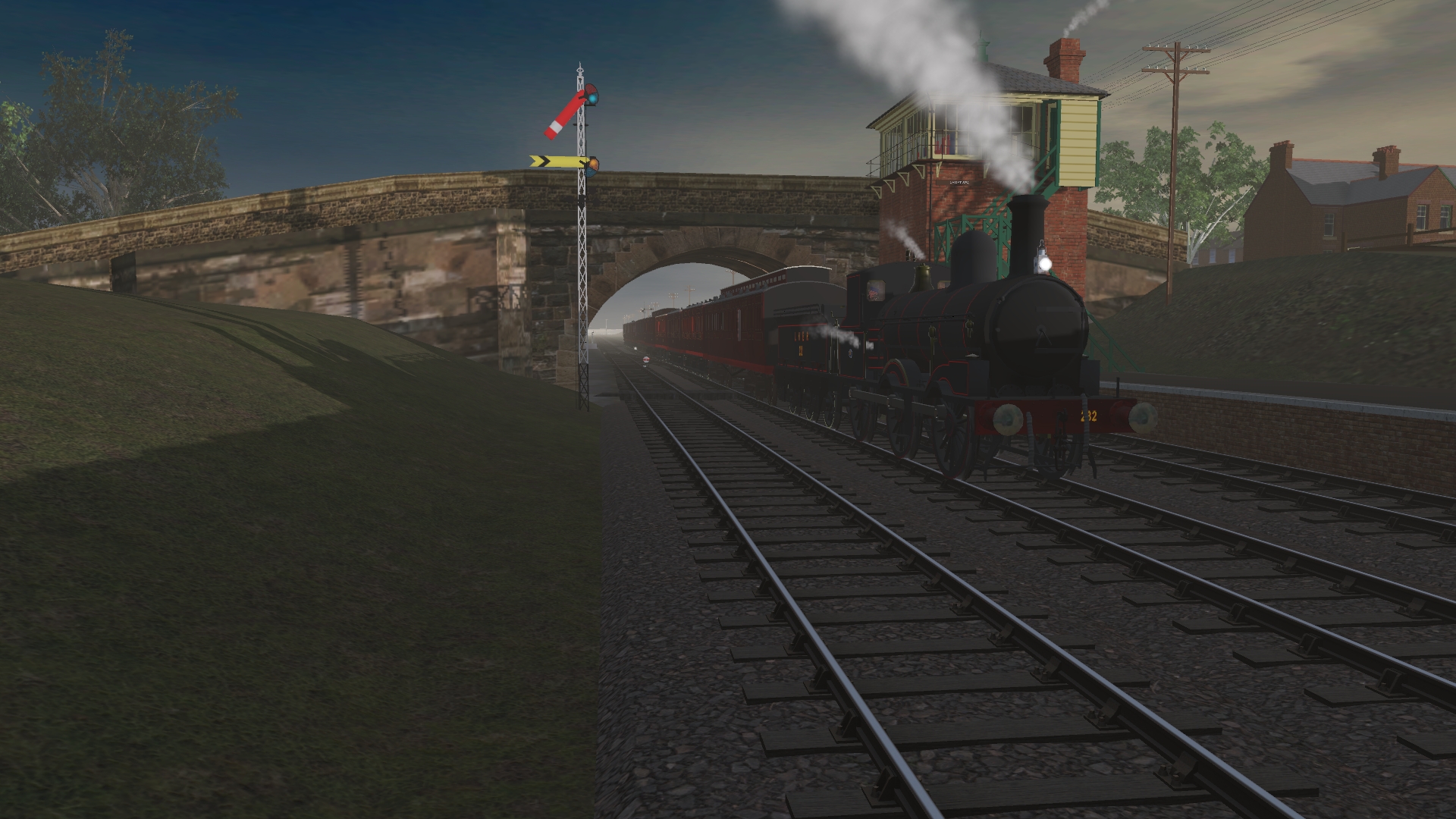
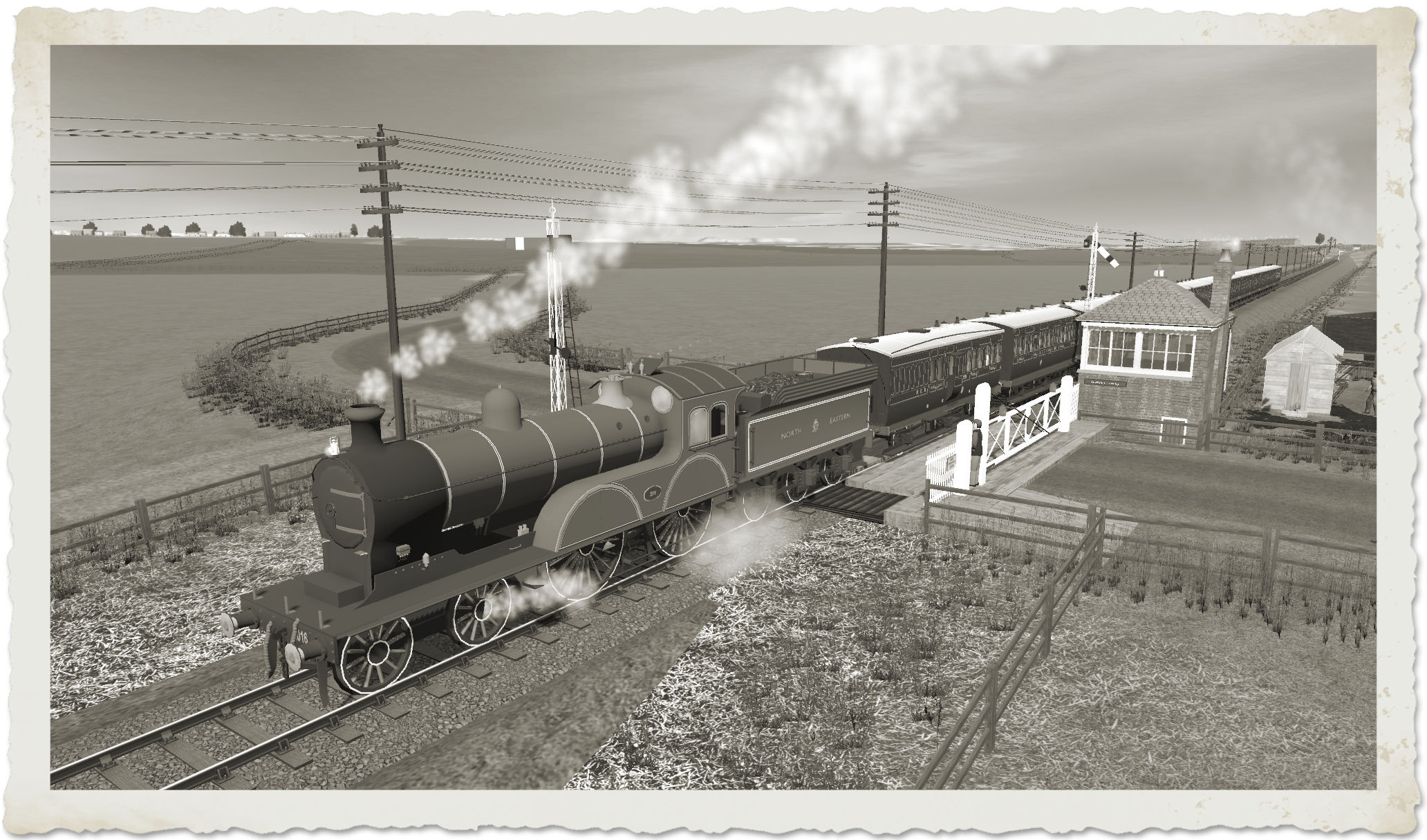
A screenshot modified to represent an early colour photo postcard.
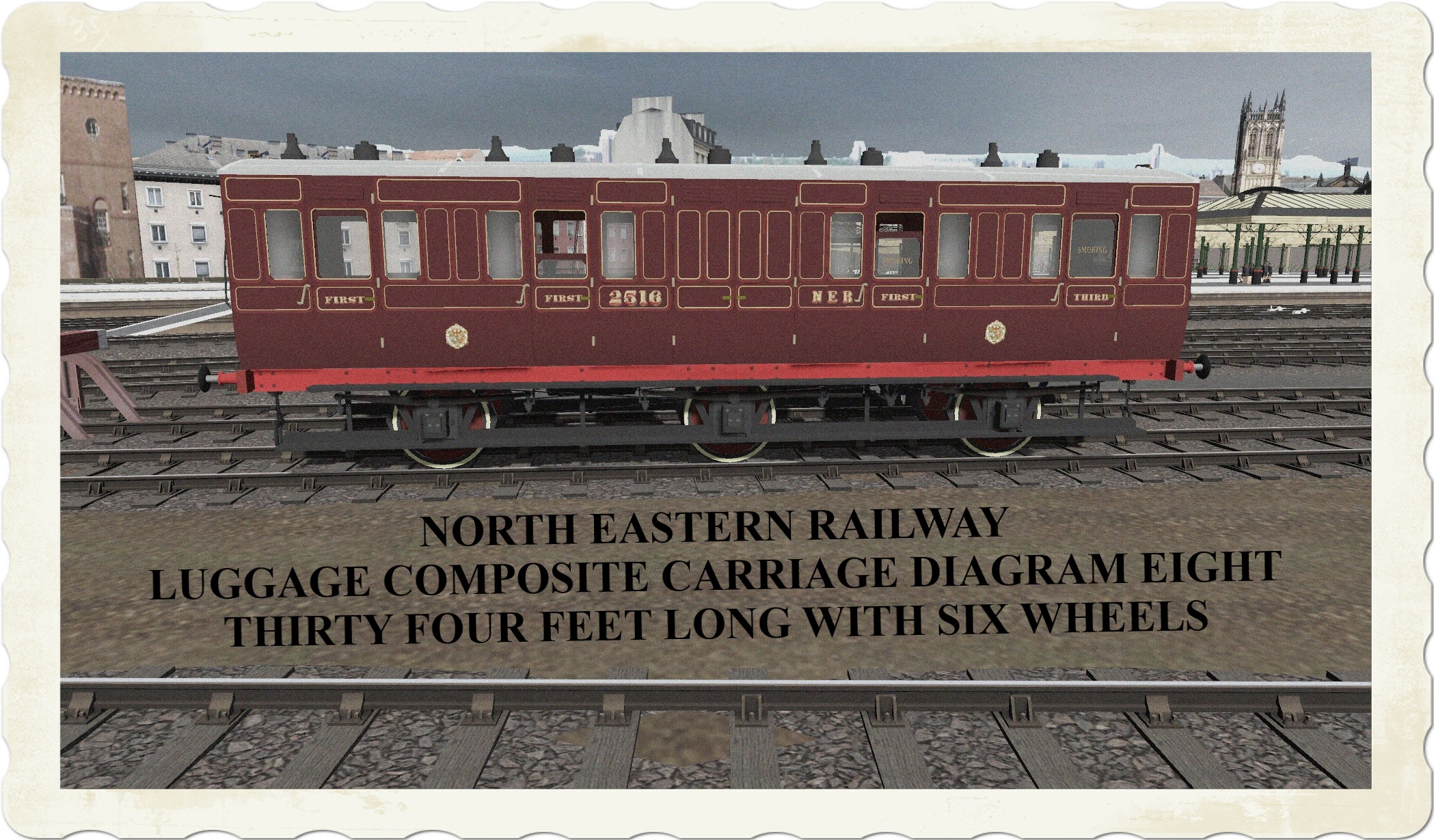
I have started on a series of commissions with Paul Mace of Paulz Trainz to produce six-wheeled carriages with luggage compartments and lavatories.
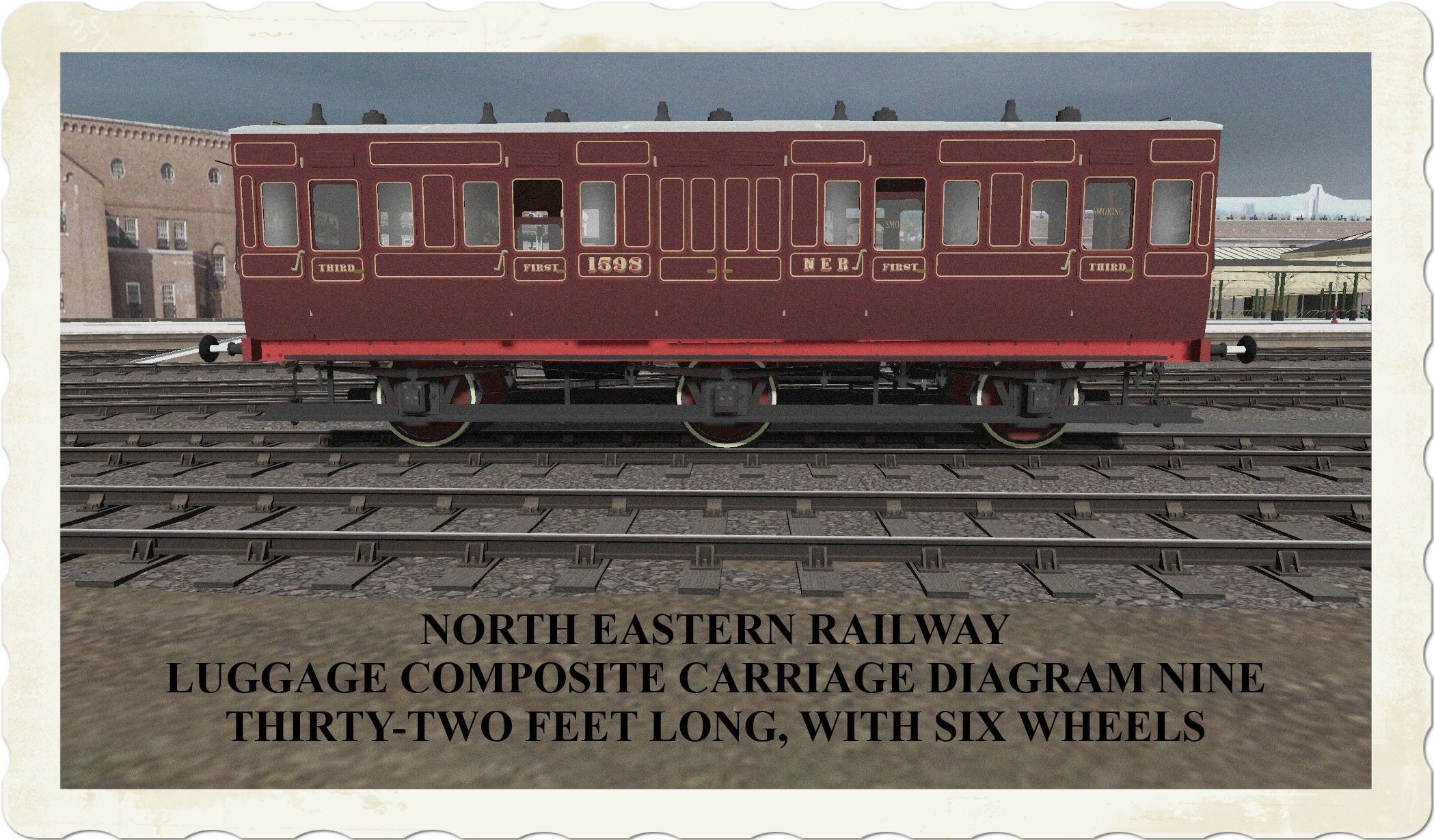
The first is the Diagram 9 Luggage Composite, with two First and two Third Class compartments with a centrally placed luggage locker.
One hundred and ninety-five were built at York between 1884 and 1893. However, according to the NER Carriage stock book one hundred and six of them had been converted to Diagram t by 1912
The stock book noted that no drawing was made for Diagram t, but this may be because the conversions were merely removing First Class interior fittings and replacing them with Third Class interiors, along with relettering of the doors. Looking at the stock book, typewritten entries indicate that fifty-eight Diagram t conversions were accomplished by December 1906, with handwritten entries showing a further forty-eight were carried out between 1907 and 1912. I believe that conversions started in 1896 as fifty-two foot bogie clerestory Luggage Composite carriages to Diagram 7 began to appear, displacing the Diagram 9 from the N.E.R's three long distance express train sets.
With One hundred and ninety five built there were far too many around to have merely been employed on the Leeds-Glasgow, Newcastle-Liverpool Exchange and Newcastle-Liverpool Lime Street sets.
Just how they were employed is unclear, since the first carriage roster we have for the North East is the 1926 LNER NE Area Carriage Roster, by which time the six-wheel type was gone apart from the luggage vans to Diagrams 21 and 171. With many 19th century long distance passengers, particularly First Class ones, tending to take a substantial amount of baggage with them then space was required to stow it. The early four wheel train carriages carried on the coaching tradition of the 18th century by stowing baggage on the carriage roof, where it was overseen by a guard sitting at the carriage end, but this practise gave way as carriages evolved, with both the guards and the baggage moving inside, out of the weather. There was just not the space to stow baggage trunks and hat boxes inside the compartment, so the guard's van was the natural place to put it.
Crime may have prompted passengers to desire their baggage to be stowed close by, where it was easier to keep their eyes on it. The archives show that stealing baggage from busy stations was done by even outwardly respectable people, such as Doctors and military officers!
It may be that the N.E.R. also deployed the Diagram 9 Luggage Composite on its "
main line sets", of which the LNER had twenty in the 1926 Carriage Roster. There were possibly twenty-one of them in N.E.R. days pre-grouping. These were not the express trains to Glasgow and Liverpool but rather the passenger sets which the NER ran along the East Coast Main Line and some the branches connected to it. York was the operational limit to their range in the south, with Tweedmouth/Berwick at the north, though one set, number seven reached Edinburgh on its daily travels. All twenty sets rotated through different daily set diagrams (set 7 did not correspond to a single physical "main line" set of carriages, it was a different one each day).
During the 1880s and 1890s of their operating heyday the Diagram 9s likely also appeared in timetabled passenger trains between Leeds and Hull, York and Scarborough, Hull and Scarborough, Newcastle and Middlesbrough as well as Newcastle and Carlisle. In other words serving the busiest stations on the N.E.R. where long distance travellers changed in and out of long distance express trains.
After 1896, they followed the established pattern of railway use of its carriages. In the beginning they would have been kept in good condition to act as substitutes and strengtheners, covering for failures and extra demand respectively. Evidently, as time progressed the company felt that they had too many of the composite type on its hands and began to convert them to all Third Class. At that time it was not the later BR practise of just declassifying a carriage but rather the replacement of First Class seating with Third Class benches, along with the removal of such things as curtains and the plush carpets. Still, the extra legroom remained, which the regular Third Class passenger will have not failed to notice, which likely made them attractive for a more spacious journey.
As enough of the new bogie carriage types were deployed a further decline down the pecking order was inevitable. The N.E.R. had a substantial excursion, special train and charter business to cater for and some of that business required First Class seating. Race Day specials were one kind of demand and Premium Excursions/Charters were others. A works, church or association/club trip might require several First Class seats for senior managers/church officials/association leaders and the like. One business, that of Party Trains ( Charters moving Theatre Groups and Music Hall companies around) might also want some First Class seating for the Group owner and leading artists.
In the end though, the six-wheeler became an anachronism and would not satisfy any passenger. Just when that came about is unclear. By the grouping, or at least 1926 they had disappeared from timetabled passenger trains, which put the N.E.R. ahead of many of its competitors. I have said before that the former G.N.R. passengers in rural Lincolnshire could still find themselves boarding an old Holden six-wheel banger as late as the end of WWII.